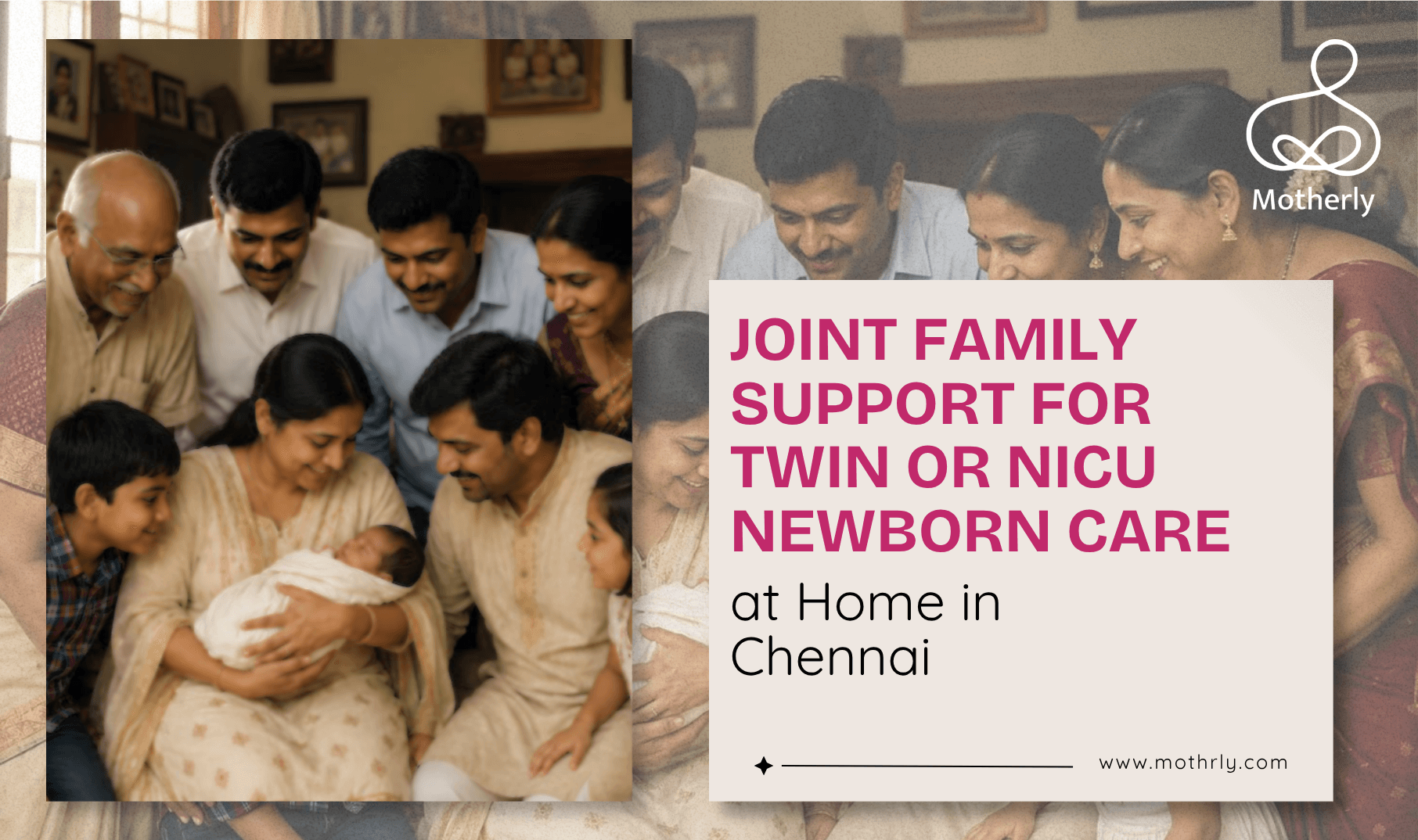
Joint Family Support for Twin or NICU Newborn Care at Home in Chennai
August 29, 2026 · Motherly Clinical Team
Joint Family Support for Twin or NICU Newborn Care at Home in Chennai
Reviewed by Mothrly’s Clinical Team — Obstetricians, Gynaecologists, Paediatricians & Postnatal Specialists | Evidence-based content for Chennai mothers
More people in the house doesn't automatically mean less pressure on the mother. This guide covers where joint family support genuinely helps with twin or NICU-graduate newborn care, and where trained care needs to sit alongside it.
Many Chennai families still bring the new mother home to a joint household after delivery. But a study of postpartum depression risk in Indian mothers found every case above the clinical cutoff came from joint-family households — a reminder that a fuller house doesn't automatically mean a lighter load. Joint family support and professional newborn care work best together, not as substitutes for each other. That combined model is exactly what Motherly's baby care support at home is built around.
Where Does Joint Family Support Genuinely Help?
- Round-the-clock presence, so the mother is never managing two babies alone overnight
- Household continuity — cooking, older children, guests — handled without the mother having to think about it
- Emotional reassurance from people who know her
- Practical experience with newborns generally — soothing techniques and routines from having raised children before
For a full-term singleton baby, this kind of support is often genuinely sufficient. Twins and NICU graduates change the equation.
Where Family Support Alone Isn't Enough for Twins or NICU Graduates
Why is twin care different from having 'extra hands'?
Twins mean two feeding schedules, two sets of weight-gain tracking, and often two different sets of needs if one twin was smaller or had a rockier start — see our guide to Twin Baby Care at Home in Chennai: What Changes With Two for what specifically changes. Extra pairs of hands help with logistics, but they don't replace someone trained to spot when one twin's feeding pattern is diverging in a way that needs medical attention.
What does a NICU-graduate baby need that general family experience doesn't cover?
- Recognising early signs of feeding fatigue or respiratory distress that look subtle in a baby who's otherwise doing well
- Following a specific weight-gain or feeding-volume protocol set by the NICU discharge team
- Managing a more infection-conscious routine — see our monsoon care guide for a season-specific example
- Knowing which symptoms genuinely need immediate medical attention versus ordinary newborn variation
| Task | Family Support / Trained Specialist |
|---|---|
| Comforting, holding, bonding | Well suited / Also appropriate, not exclusive |
| Household and meal support | Well suited / Not the specialist's role |
| Tracking feeding volumes and weight trends | Inconsistent without training / Structured, protocol-based |
| Spotting early medical warning signs | Variable / Trained specifically for this |
| Overnight clinical monitoring for a fragile baby | Exhausting for family over time / Designed for sustained, alert care |
Twins or a NICU graduate at home deserve trained eyes, not just extra ones.
How Do You Divide Roles Without Family Tension?
- Be specific, not general — name exact time blocks for each person, rather than a vague division of labour
- Frame the specialist's role as medical, not as replacing family — most families accept this once it's tied to what the NICU discharge team recommended
- Keep one person as the point of contact for the paediatrician and any home care specialist
- Protect the mother's rest windows explicitly, since 'help' can default to advice-giving rather than actually taking a shift
What Does Blending Both Kinds of Support Actually Look Like Day to Day?
A realistic split for a Chennai household with twins or a NICU-graduate baby, and grandparents involved:
- Grandparents/family — overnight presence and comfort during non-critical hours, household management, older-child care, emotional support for the mother
- NICU-trained home care specialist — feeding protocol adherence, weight and symptom tracking, recognising and escalating warning signs, structured handover notes for the paediatrician
- Mother — protected rest blocks, bonding time without the pressure of also monitoring clinical details, one trusted source of guidance instead of conflicting advice
This is the model behind Motherly's baby care support at home — built to sit alongside family involvement, not compete with it. A doula in the earlier weeks, and a lactation specialist for the feeding side, round out the same model — see our guides to Doula Services in Chennai: What a Doula Does for New Mothers and Lactation Support at Home in Chennai: What Ongoing Help Looks Like.
How Do You Set This Up Without Anyone Feeling Sidelined?
- Involve grandparents in the conversation with the specialist early, so they understand what the trained role covers
- Frame it around the baby's specific medical history rather than a general comment on family caregiving
- Let family keep the roles they're naturally suited to — comfort, presence, tradition — while the specialist covers what training specifically requires
Getting this balance right in the first weeks sets the tone for the months that follow.
Frequently Asked Questions
Do we need a NICU-trained specialist even if grandparents have raised several children before?
General childcare experience is valuable, but it doesn't cover NICU-specific protocols, twin feeding-volume tracking, or the subtle warning signs a specialist is trained to catch.
How long do families typically need this kind of combined support?
It varies by the baby's medical history, but many families scale down trained specialist support after the first several weeks, once feeding and weight gain are clearly stable.
What if grandparents feel their help isn't wanted once a specialist is involved?
Framing the specialist's role as specifically medical and protocol-based usually resolves this once family understands it's about the baby's needs, not a comment on their capability.
Can a specialist coordinate directly with our paediatrician?
Yes — a NICU-trained home care specialist should be tracking feeding, weight, and any concerning symptoms in a way that can be shared directly with your paediatrician at follow-up visits.
For more on the specific care twins and NICU graduates need, see our guides to Twin Baby Care at Home in Chennai: What Changes With Two, NICU Baby Care at Home in Chennai: What Happens After Discharge, and our companion piece on Monsoon Care for Premature & NICU Babies at Home in Chennai, or browse the full Motherly blog.
Related Reading on the Motherly Blog
- Twin Baby Care at Home in Chennai: What Changes With Two
- NICU Baby Care at Home in Chennai: What Happens After Discharge
- Premature Baby Care at Home in Chennai: After NICU Discharge
- Monsoon Care for Premature & NICU Babies at Home in Chennai
- Doula Services in Chennai: What a Doula Does for New Mothers
- Newborn Care Made Easier: What a Baby Care Specialist Does in Chennai
⚠ Medical Disclaimer
This article is written by Mothrly's clinical team for educational purposes only. It does not constitute medical advice and must not replace consultation with a qualified healthcare professional. Individual circumstances vary — always seek personalised guidance from your doctor, gynaecologist, paediatrician, or specialist.
You Deserve Proper Care Too — Not Just Your Baby
Book online or download the app to find your verified support specialist in Chennai.