Family
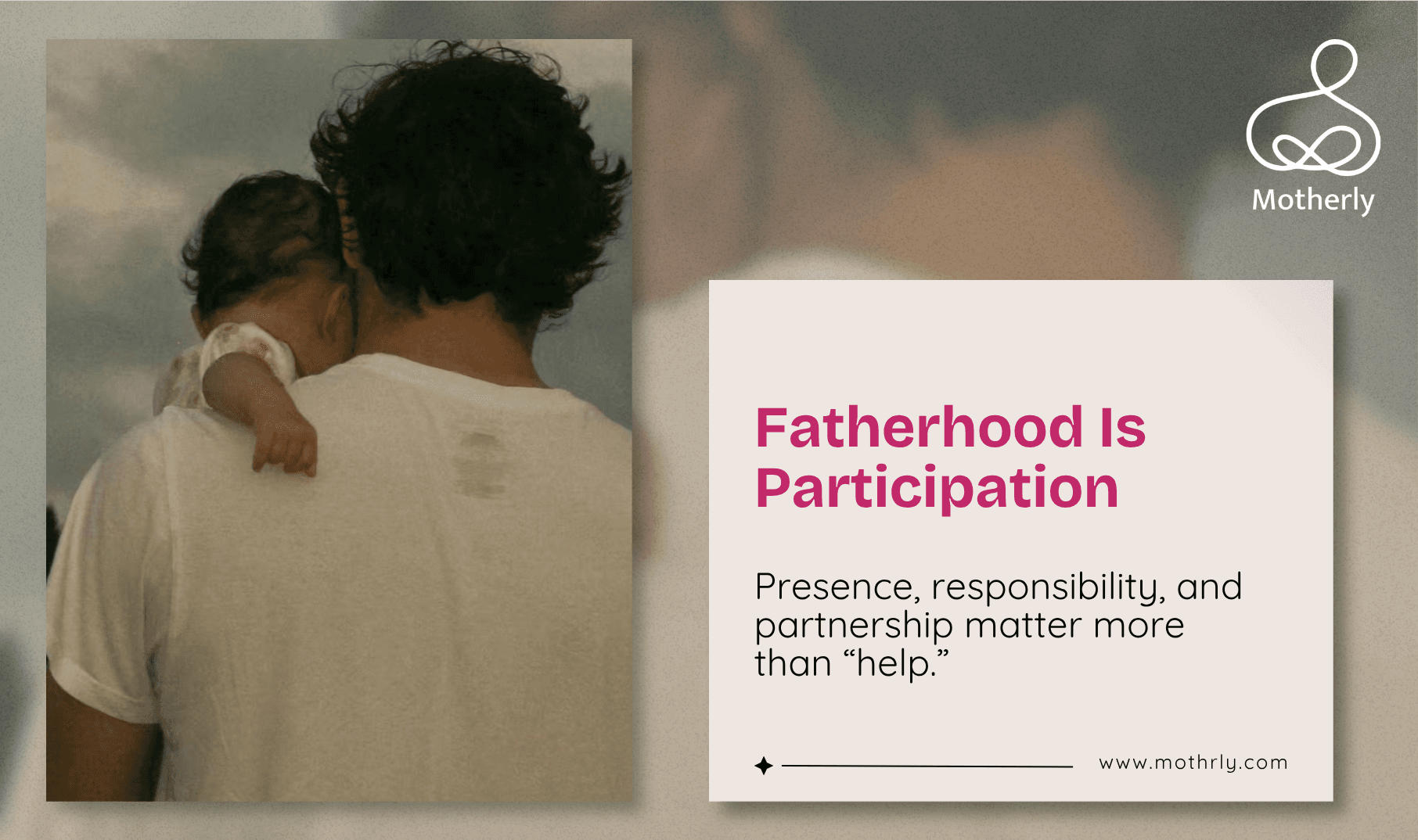
The Father’s Role Is Not Helping. It Is Participating. The Difference That Changes Everything for Mother and Child
motherly·May 22, 2026
✓
Motherly — The difference between a father who helps and a father who participates as an equal partner changes everything for the mother, the child, and the father himself.
There is a phrase that reveals a fundamental misunderstanding in how many families approach parenthood: ‘he helps with the baby.’ The word ‘helps’ positions the father as an assistant in a project that belongs primarily to the mother. It implies that the default owner of childcare is the mother, and the father’s contribution is a generous addition to her primary responsibility. This framing is so deeply embedded in Indian family culture — and in most other cultures globally — that it is rarely questioned. But it should be. Because the difference between a father who helps and a father who participates as an equal partner is the difference between two fundamentally different experiences of parenthood — for the mother, for the child, and for the father himself.
“The tasks are the relationship, in the earliest months.”
What the research consistently shows
Decades of developmental psychology research show unambiguously that children with involved fathers — fathers who are present, engaged, emotionally available, and actively caring — develop better cognitive outcomes, stronger emotional regulation, more secure attachment, and greater resilience than children whose fathers are present but uninvolved. This is not because fathers are inherently superior caregivers to mothers. It is because two deeply invested caregivers, each with a slightly different relational style, provide a richer developmental environment than one exhausted primary caregiver and one pleasant but peripheral secondary presence.
What a truly present father does for the mother
The impact of paternal involvement on maternal wellbeing is one of the most consistent findings in postpartum research. Mothers with genuinely supportive, sharing partners experience significantly lower rates of postpartum depression, higher satisfaction with their relationship, better physical recovery after birth, and more positive experiences of early breastfeeding. The exhaustion and isolation that characterises early motherhood for many women is not an inevitable feature of the experience. It is in significant part a consequence of the unequal distribution of labour and the emotional weight that falls on the mother when the father’s role is defined primarily as provider and secondarily as helper.
The father's own transformation
The transformation that parenthood brings to a father is real, but it is often delayed relative to the mother’s experience. The mother’s transformation begins during pregnancy, when the physical reality of the growing child creates a continuous, embodied awareness of the new life. The father’s transformation typically begins later — often at birth, sometimes weeks after — and develops more fully through physical proximity and direct care. A father who changes nappies, bathes the baby, settles the baby at night, carries the baby through colicky evenings, sings the same song forty times in succession — this father is not just doing tasks. He is building an attachment that will define his relationship with his child for decades. The tasks are the relationship, in the earliest months.
Redefining fatherhood for the Indian family
The Indian father has traditionally been defined primarily as provider, authority figure, and emotional anchor — a role that is deeply important and should not be dismissed. But the provider-protector model of fatherhood, when it excludes active nurturing participation, produces a specific kind of distance between fathers and children that many Indian adults carry into their own adult lives as a formative wound. The father who was present but not proximate. Who provided but did not comfort. Who was respected but not known. Closing this distance — in the next generation, through the choices contemporary fathers make about how they show up in the daily life of their children — is one of the most important things the Indian family can do.
A Supported Mother Changes Everything
Motherly supports both mothers and the families around them. Because a supported mother changes everything. Visit mothrly.com.
M
Motherly Editorial Team
Written by Motherly’s editorial team — dedicated to supporting women through pregnancy, birth, postpartum recovery, and early motherhood with compassion, dignity, and expert care.
Keep Reading
DOULA CARE
The Complete Guide to Choosing the Right Doula for Your Birthing Journey
Choosing a doula? Learn what a doula does, how to interview candidates, check training and costs, and spot red flags be…
September 30, 2026
BREASTFEEDING
Overcoming Early Breastfeeding Challenges: Expert Advice from Lactation Consultants
Struggling with early breastfeeding? Lactation consultants explain how to fix latch problems, sore nipples, low milk wo…
September 30, 2026