Trying to Conceive
You Are Not Broken. You Are Not Alone. The Honest Truth About What It Actually Feels Like to Try and Not Succeed.
motherly·May 29, 2026
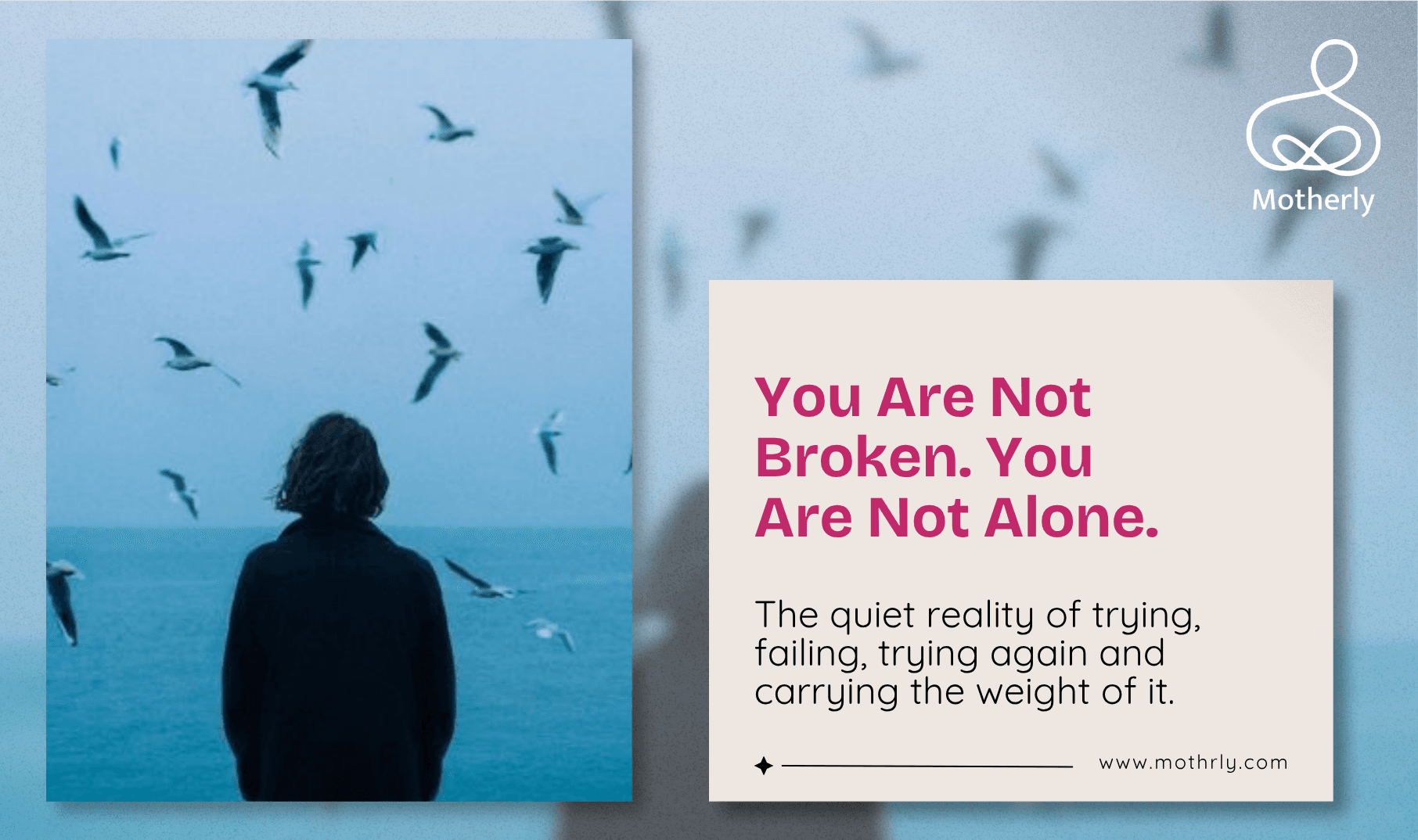
Motherly — Trying to conceive can be emotionally overwhelming, and the private cycle of hope and loss deserves acknowledgement, honesty, and meaningful support.
There is a specific kind of grief that arrives every month, on a specific day, when the test shows one line instead of two. It is not a grief that has a name in any language that most cultures acknowledge. It is not a grief that your colleagues know about, or that your mother necessarily understands, or that the world has rituals for. It is a private, repetitive loss - the loss of something that has not yet existed but that you have already begun to love. If you are living this, you already know exactly what it feels like. The first thing you need to hear is this: you are not broken. You are not being punished. You are not failing at something other women find easy. You are going through one of the most emotionally complex experiences a human being can endure, and you are going through it, in most cases, largely alone.
The month that never ends
The two-week wait is one of the most psychologically difficult periods in fertility treatment, or in trying to conceive without treatment. Your body produces every symptom of early pregnancy during the luteal phase regardless of whether implantation has occurred, because the same hormones are present either way. So you interpret every twinge, every wave of nausea, every moment of fatigue as a possible sign. You construct hope from physiology. Then the test, or the period, tells you that you were constructing. You have to dismantle everything you built, quietly and privately, and begin again. This monthly cycle of hope and loss, repeated month after month, has a cumulative psychological cost that is well documented. Studies consistently show that women undergoing fertility treatment or prolonged attempts to conceive experience levels of anxiety and depression comparable to those with serious illness diagnoses.
"You are not failing. You are carrying a private grief that deserves to be seen."
The things people say that do not help
"Just relax and it will happen." "Have you tried eating pineapple?" "Maybe it is not the right time." "At least you know you can get pregnant." "My friend tried for five years and then it happened naturally." These are usually not malicious statements. They come from people who want to help and do not know how. But they land as minimisations, sometimes as accusations, because underneath each one is an implication that you are doing something wrong or managing this badly. None of that is true. The experience is as hard as it feels. Naming this clearly, to yourself first and where possible to people around you, is not self-pity. It is honesty, and honesty is where meaningful support begins.
What the research tells us about the emotional toll
Multiple large studies, including landmark work published in the British Medical Journal, have found that the psychological distress of infertility and fertility treatment can be equivalent to the distress of a cancer diagnosis. Women who experience failed treatment cycles show elevated cortisol, disrupted sleep, reduced social functioning, and symptoms that meet clinical criteria for adjustment disorder, anxiety disorder, or depression at rates significantly higher than the general population. This is not weakness. It is a normal response to a sustained experience of loss and uncertainty.
What actually helps
What helps is being seen. Being told by a doctor who sits with you rather than at you, by a partner who says "I am here for whatever this is," and by a community of women who understand the two-week wait, that this is real and it matters. It helps to know the biology: conception in a single cycle has only a 15-25% probability even in healthy, fertile couples, and most couples trying naturally take six to twelve months. It helps to have a plan, to know what investigations to seek if nothing has happened by six months, and to know what questions to ask at the first appointment. It helps to be honest about what you need, whether that is better information, emotional support, a break from tracking, counselling, or simply someone who can sit beside you in the difficulty without trying to fix it.
You Belong Here
At Motherly, we understand the journey before the baby. You belong here, at every stage.
Keep Reading

DOULA CARE
The Complete Guide to Choosing the Right Doula for Your Birthing Journey
Choosing a doula? Learn what a doula does, how to interview candidates, check training and costs, and spot red flags be…
September 30, 2026

BREASTFEEDING
Overcoming Early Breastfeeding Challenges: Expert Advice from Lactation Consultants
Struggling with early breastfeeding? Lactation consultants explain how to fix latch problems, sore nipples, low milk wo…
September 30, 2026