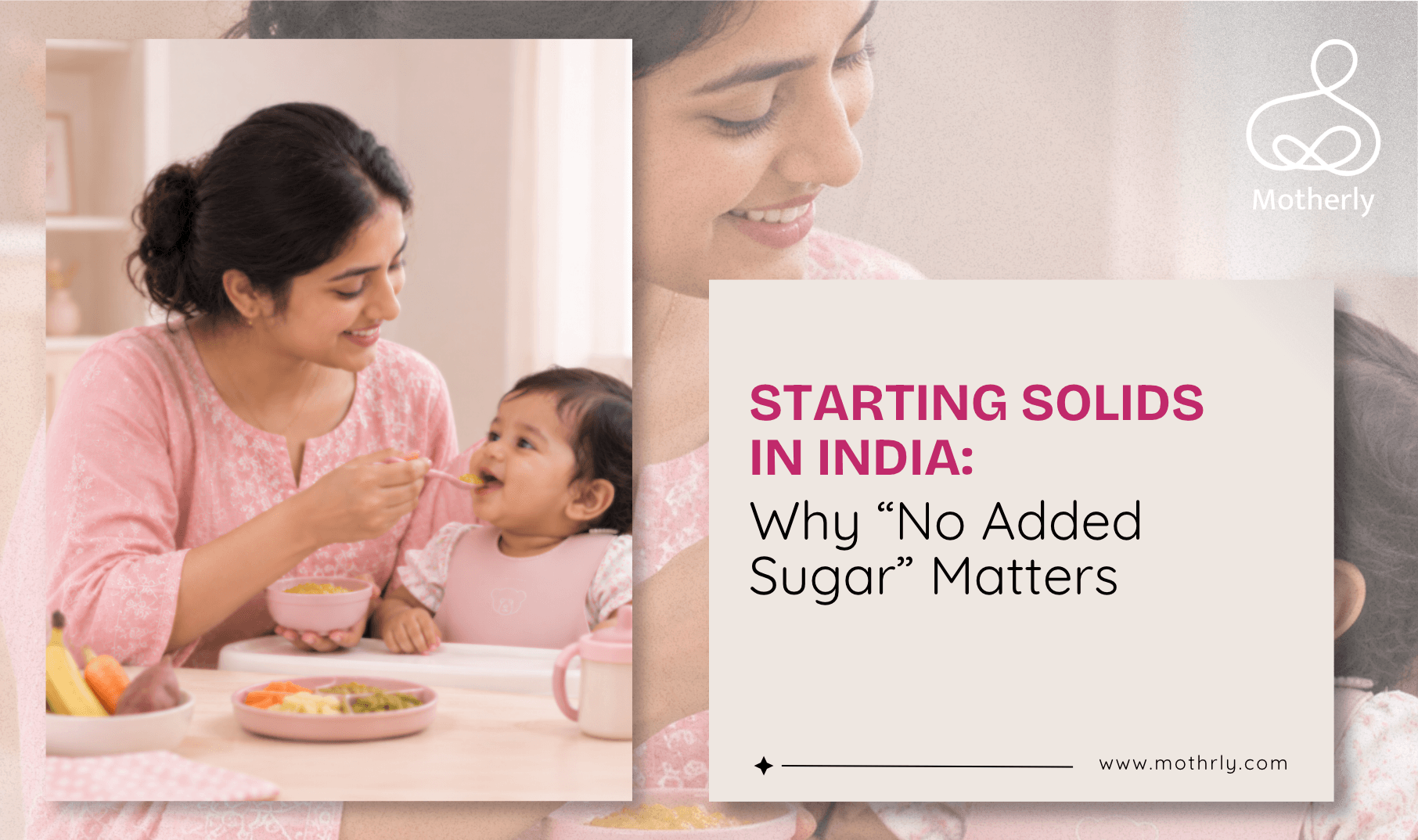
Starting Solids in India: When to Begin, What to Feed and Why "No Added Sugar" Matters
November 4, 2026 · Motherly Team
Starting Solids in India: When to Begin, What to Feed and Why "No Added Sugar" Matters
Start complementary foods soon after your baby completes 6 months, offering homemade, semi-solid foods alongside continued breastfeeding, with no added sugar and minimal salt, as ICMR-NIN's 2024 Dietary Guidelines for Indians advise.
- Breastfeed exclusively for 6 months, then continue to 2 years and beyond.
- ICMR-NIN says no added sugar for children under 2; jaggery and honey count as added sugar.
- A 2024 Public Eye and IBFAN report found infant cereals sold in India averaged about 2.7 g added sugar per serving, prompting an FSSAI review.
- Read labels, choose homemade first, and ask your paediatrician about iron.
When should I start solids?
ICMR-NIN's guidelines recommend exclusive breastfeeding for 6 months, then homemade semi-solid foods soon after 6 months while breastfeeding continues, preferably to 2 years. Watch for readiness too: sits with support, good head control and interest in your food. Feed patiently and never force. For early guidance on first foods, see our article on introducing first solid foods.
Why is added sugar a concern?
The same guidelines advise no added sugar for children under 2 and no sugar or salt in complementary foods, avoiding biscuits, cakes, juices and cold drinks. A 2024 investigation by Public Eye and IBFAN found all 15 infant cereals tested in India contained added sugar, about 2.7 g per serving on average, and FSSAI set up an expert panel to review infant-food norms. Recent reporting notes that proposed restrictions focus on products for infants up to six months while the dietary guidelines cover under-2s, so the regulatory debate is ongoing. Early sweetness shapes taste preferences, which is why a no-added-sugar start is a simple, low-cost habit.
How do I read a baby food label?
Ingredients are listed by weight, so sugar near the top is a warning. Added sugar hides under many names:
| Look for | Also means |
|---|---|
| Sugar, sucrose, glucose, glucose syrup | Added sugar |
| Malt extract, maltodextrin, invert sugar | Added sugars or fast carbohydrates |
| Honey, jaggery, fruit juice concentrate | Still added sugar, and honey is unsafe under 1 year |
| "No refined sugar" claims | Check the full list; the product may still contain other sugars |
Treat packaged cereals as an occasional travel option, not a daily base.
What are the best first foods?
| Age | Texture | Examples (all unsweetened) |
|---|---|---|
| 6 to 8 months | Smooth, thick purees and mashes | Ragi porridge, rice-dal khichdi mash, mashed banana, steamed apple or pear, well-cooked egg, curd |
| 9 to 11 months | Lumpy mashes, soft finger foods | Idli strips, soft dosa pieces, vegetable khichdi, paneer crumbles, soft-cooked carrot sticks |
| 12 to 23 months | Family foods, cut small | Rice, roti pieces, dal, vegetables, fish or chicken, fruit; add salt only minimally |
WHO infant feeding frequency guidelines recommend about 2 to 3 meals a day at 6 to 8 months and 3 to 4 meals plus 1 to 2 snacks from 9 months, with breastfeeds continuing. Include iron-rich foods such as ragi, dals, green leafy vegetables with a vitamin C food, egg, fish or meat, and ask your paediatrician about iron drops. Jaggery adds sugar and is not a meaningful iron source for babies. Check our article on 5 signs your baby is getting enough breast milk to maintain balance alongside solids.
Not sure what or how much to feed?
Get a personalised weaning plan, growth check and iron advice from a verified paediatrician, at home or online.
A 7-day no-sugar starter plan
This is Motherly's sample, not a prescription. Introduce one new food at a time and wait 2 to 3 days before adding another:
| Day | Meal 1 | Meal 2 |
|---|---|---|
| Day 1 | Thin ragi porridge | Mashed banana |
| Day 2 | Rice-moong dal mash | Steamed apple puree |
| Day 3 | Sooji or oats porridge with breast milk | Mashed sweet potato |
| Day 4 | Khichdi with ghee and mashed carrot | Plain curd (from about 8 months if your paediatrician agrees) |
| Day 5 | Ragi dosa, soft, mashed | Mashed papaya |
| Day 6 | Well-cooked egg yolk, then whole egg if tolerated | Dal water with rice mash |
| Day 7 | Vegetable khichdi with palak | Mashed pear |
If you want to introduce allergens such as egg or peanut, discuss timing and form with your paediatrician, particularly if your baby has eczema or a family allergy history.
How do I keep feeding safe?
- Seat your baby upright and stay with them while they eat.
- No honey before 1 year, no whole nuts, whole grapes, popcorn or raw hard chunks.
- Offer small sips of water from a cup with meals after 6 months.
- Wash hands, and use freshly prepared or properly refrigerated food. See our monsoon fever guide for when diarrhoea or fever needs a doctor.
- Keep breastfeeding on demand. If you're balancing work and feeding, read our guide on returning to work after maternity leave.
Make mealtimes easier
Talk to a paediatrician about portions, allergies and growth, without waiting in a clinic.
Frequently Asked Questions
1. Is jaggery better than sugar for babies?
No. Both are added sugar. ICMR-NIN advises none under 2 years.
2. Can I give cow's milk or fruit juice?
Curd is fine as a food, but cow's milk as a main drink is usually delayed until after 12 months. Whole fruit is better than juice.
3. Is baby-led weaning safe in India?
It can be, using soft, appropriately sized foods such as idli strips and steamed vegetable sticks, with supervision and an upright seat.
4. My baby refuses new foods. Should I worry?
Refusals are common. Offer the food many times without pressure and watch growth with your paediatrician.
5. How much solid food should my baby eat?
At 6 months, start with a few spoonfuls and build up as your baby shows interest. Breast milk remains the main nutrition early on.
Related Reads
- Newborn Winter Care in India.
- Returning to Work After Maternity Leave.
- Pediatrician Services in Chennai.
- Baby Care Services.
Medical Disclaimer: This article is for general information and education only and is not a substitute for professional medical advice, diagnosis or treatment. Feeding plans, allergen introduction and supplements such as iron must be tailored by your paediatrician. Seek urgent care for choking, breathing difficulty, swelling or hives after a food. In an emergency call 112 or go to the nearest hospital. Motherly's services complement, and do not replace, care from your treating doctor.
Related

Air Pollution and Pregnancy in India: How to Protect Your Baby During Diwali Smog and Winter AQI Spikes
November 4, 2026

Baby Fever and Cough in the Monsoon-to-Winter Shift: Dengue, Viral Fever and When to Call the Doctor
November 4, 2026

Newborn Winter Care in India: Safe Room Warmth, Heater and Angeethi Risks, and Baby Oil Massage
November 4, 2026